

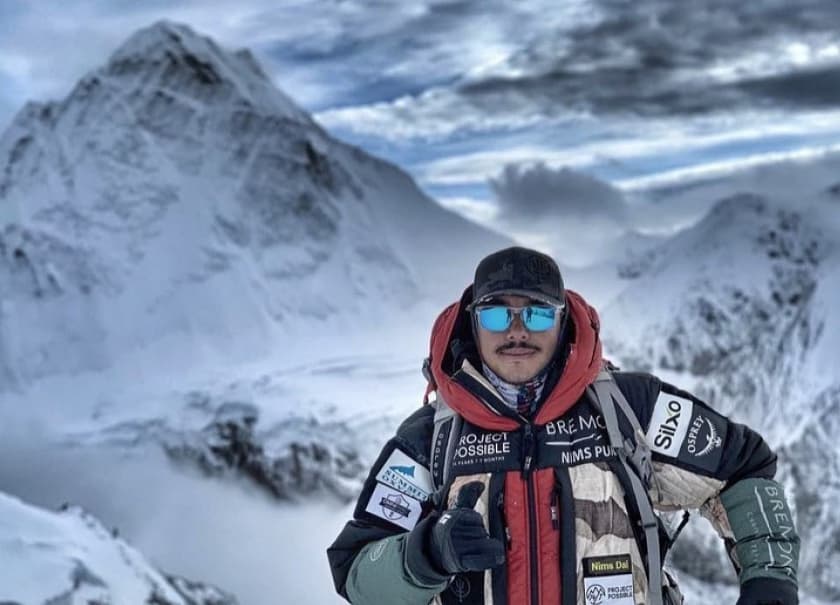
A heartfelt chronicle of the Broad Peak avalanche, the life of a fearless legend, and the indelible mark left on Nepal and global mountaineering. Today’s blog news post of Nepal High Trek is sad and it is to remember the great Nepalese mountaineering hero, Nirmal Purja (NIMS DAI). We pay huge homage and offer heartfelt condolences to his families. All of us are finding it hard to believe that Nims Dai is no more with us!
There is a specific, suffocating silence that settles over the high Himalayas and Karakoram when disaster strikes the high altitude. It is not the clean silence of wind sweeping over mountain ridges, but a heavy, unbearable quiet borne of total disbelief.
For years, Nirmal "Nims Dai" Purja moved through the world’s most lethal "death zones" above 8,000 meters with an aura that felt almost superhuman. He was the former British Special Forces operator turned high-altitude legend who rewrote human limits, summited all fourteen of the world’s 8,000-meter peaks in a mind-boggling six months, spearheaded the historic first winter ascent of K2, and forced the entire global community to recognize Nepali mountaineers not as nameless background helpers, but as the world's finest elite leaders.
Yet, on July 30, 2026, the harsh, indifferent reality of the Karakoram range delivered a devastating blow. A massive avalanche on Pakistan's Broad Peak swept through a 10-member expedition team near Camp III, taking the lives of Nirmal Purja and his loyal climbing brothers.
As the tragic news was formally confirmed on August 1, 2026, by Elite Exped and local mountain authorities, grief reverberated from the quiet streets of Kathmandu to climbing hubs in Chamonix, Skardu, and beyond.
Avalanche on Broad Peak: What Happened on July 30, 2026?
Broad Peak, standing at 8,047 meters (26,401 feet) in northern Pakistan, is the world’s 12th highest mountain. It is positioned just across the Godwin-Austen Glacier from K2, it is notorious for treacherous ice walls, narrow exposed ridges, and unpredictable, explosive avalanche conditions during the summer climbing season.
On the morning of Thursday, July 30, 2026, Nims Dai was leading a high-profile expedition toward the summit. His team included trusted Nepali mountain guides—seasoned veterans who had stood alongside him on dozens of extreme summits, as well as international clients from Oman, China, the United States, and Pakistan.
At approximately 9:00 AM local time, at an altitude of around 7,000 meters just below Camp III, a massive slab of wind-drifted ice and hard snow detached high up the mountain face. Without warning, thousands of tons of heavy snow roared down the slope, catching the 10-member team directly in its path.
The force of the avalanche was horrific. GPS tracking data from Nims Dai’s satellite unit recorded a sudden, catastrophic drop: at 9:38 AM, his location registered at 6,659 meters; by 10:18 AM, the signal had plummeted nearly 1,000 meters downhill to 5,891 meters. It was the digital blueprint of an unstoppable slide.

The Desperate Search in the Karakoram
In the hours that followed, a heroic but agony-filled search and rescue operation was launched. Two Pakistan Army Aviation helicopters battled fierce Karakoram winds, while ground search crews composed of local high-altitude porters and fellow expedition companies—including Seven Summit Treks and Imagine Nepal—strained to locate survivors amidst the massive debris field.
Initial hopes flared briefly when tracking signals showed slight positional movements, but rescue coordinators soon recognized these as sensor glitches or shifting snow mass. Bad weather, zero-visibility fog, and continuous loose snow slides severely hampered search efforts.
On Friday, rescuers recovered the first bodies from the snow mass. By Saturday, August 1, 2026, the grim truth could no longer be held back: Nirmal "Nims Dai" Purja, along with his cherished Nepali companions—Pur Bahadur Gurung (Yukta), Nima Sherpa, Kili Pemba Sherpa, Gyalu Sherpa, and Nawang Thindu Sherpa—had lost their lives in the disaster. International team members were also among the casualties.
When Elite Exped released its official statement on Saturday afternoon, confirming the loss of its founder and crew, a wave of heartbreak washed across Nepal.
"It is with profound sadness and immense heartbreak that we confirm that Nirmal 'Nimsdai' Purja tragically lost his life following the avalanche on Broad Peak... We have lost brothers, leaders, and true sons of the mountains."
The Boy from Dana Who Refused the Word "Impossible"
To comprehend why this loss cuts so deeply into the human spirit, one must understand the sheer distance Nirmal Purja traveled in his lifetime—not just in altitude, but in life.
Born in July 1983 in the small, mountain-shadowed village of Dana in Nepal’s Myagdi district, Nims grew up far removed from the wealth, corporate sponsorships, and Western patronage that historically opened doors in high-altitude mountaineering. Raised in Chitwan after his family moved down to the plains, he was raised in a modest family with deep military roots.
From childhood, Nims possessed an intense, burning ambition. At 18, he earned a coveted spot in the British Gurkha Regiment—a fierce military order with over two centuries of bravery. But Nims was never content staying within comfortable boundaries. In 2010, after six years with the Gurkha Rifles, he shattered another ceiling by becoming the first Nepali ever to pass selection for the Special Boat Service (SBS), the elite special forces unit of the British Royal Navy.
For six years in the SBS, Nims operated in secret, ultra-high-stress cold-weather environments and maritime combat roles. It was during a cold-weather military training exercise and a holiday trek to Everest Base Camp in 2012 that his passion for extreme mountaineering was truly ignited.
Project Possible: 14 Peaks in 6 Months
In early 2019, Nims made a decision that many around him called foolish: he resigned from the British military, walked away from a lucrative pension and a secure career, and remortgaged his home in the UK. His goal? Project Possible 14/7—a quest to scale all 14 of the Earth's "eight-thousanders" (mountains over 8,000 meters, all located in the "Death Zone" where atmospheric pressure provides less than a third of sea-level oxygen).
At the time, the world record for climbing all 14 peaks stood at 7 years, 11 months, and 14 days, held by Polish legend Jerzy Kukuczka. Western mountaineering experts openly declared Nims Dai’s goal of doing it in under seven months impossible. Sponsors turned him down; diplomatic red tape threatened to close borders on him.
.avif)
Nims answered with relentless action, absurd physical stamina, and unyielding positivity.
Between April 23, 2019, and October 29, 2019—a mere 6 months and 6 days—Nims Dai summited Annapurna, Dhaulagiri, Kanchenjunga, Everest, Lhotse, Makalu, Nanga Parbat, Gasherbrum I, Gasherbrum II, K2, Broad Peak, Cho Oyu, Shishapangma, and Manaslu. During that whirlwind, he also took the iconic, viral photo of the massive traffic jam on Mount Everest's Hillary Step, exposing the reality of modern commercial climbing to the entire world.
When asked how he pushed his body through horrific frostbite risks, high-altitude pulmonary edema hazards, and sleep deprivation, his answer was simple:
"I don't climb for personal glory. I climb to show every human being on Earth that when you back your dreams with total heart and discipline, nothing is impossible."
The First Winter Ascent of K2 — Reclaiming Nepali Dignity
If Project Possible proved his individual physical mastery, what happened in January 2021 proved his deep love for his people and culture.
For decades, K2 in winter was considered the last great "unsolvable problem" in alpine mountaineering. Dozens of elite European, Russian, and American expeditions had tried for 30 years and failed, beaten back by -60°C temperatures and hurricane-force winds exceeding 100 mph.
On January 16, 2021, Nims Dai, operating without supplementary oxygen during his final push, organized and led a 10-member all-Nepali climbing team to the summit of K2 in the dead of winter.
As they approached the final 10 meters of the summit ridge, Nims Dai halted the group. Rather than racing ahead to claim individual glory, the ten Nepali climbers paused, linked arms, and stepped onto the summit together, singing the Nepali national anthem ("Sayaun Thunga Phool Ka").
It was a moment that sent chills through the international sporting world. For more than a century, foreign climbers had claimed the headlines, while indigenous Sherpas and Nepali high-altitude workers carried the heavy loads, fixed the ropes, risked their lives in Khumbu Icefalls, and remained anonymous in historical footnotes.
In that single, glorious moment on top of K2, Nims Dai and his brothers didn't just climb a mountain—they dismantled a century of historical erasure. They showed that Nepali climbers were not mere support staff; they were the ultimate masters of the high mountains.
A Transformative Legacy on Nepal’s Tourism Industry
It is impossible to overstate the seismic impact Nirmal Purja had on Nepal's economy, culture, and global image.
1. The Commercial Paradigm Shift
Before Nims Dai, Western guiding agencies dominated the luxury expedition market on Everest, K2, and Ama Dablam. Foreign companies charged $70,000 to $100,000 per climber, while paying local Sherpas meager seasonal wages for life-threatening labor.
Nims Dai co-founded Elite Exped, demonstrating that a Nepali-owned, Nepali-operated agency could provide world-class safety protocols, high-end hospitality, military-grade logistics, and superior technical guiding. This paved the way for a generation of young Sherpas to become entrepreneurs, agency owners, and internationally certified IFMGA guides rather than low-paid hired hands.
2. A Global Tourism Catalyst
The release of his 2021 hit Netflix documentary, 14 Peaks: Nothing Is Impossible, served as a multi-million dollar promotional campaign for Nepal. It showcased the breathtaking beauty of the Himalayas and the warm, resilient spirit of its people to tens of millions of homes worldwide.
In the years following the film, trekking and climbing bookings in Nepal surged. Regions like Myagdi, Manang, Mustang, and Solukhumbu saw an influx of international travelers drawn by the stories of courage Nims Dai brought to life.

The Irreparable Damage to Global Mountaineering
The tragic accident on Broad Peak leaves the global mountaineering community staggering under an incredible sense of loss.
Nims Dai was more than an athlete; he was a bridge between distinct worlds. He bridged the tactical rigor of elite military forces with the raw, artistic passion of high-altitude alpine climbing. He bridged the gap between traditional Western climbing culture and the rising confidence of Asian and indigenous mountaineers.
When a figure of Nims Dai’s experience, physical conditioning, and tactical wisdom falls victim to an avalanche, it sends a chilling message across the global climbing sector: The mountains recognize no masters.
A Loss of Leadership and Vision
The loss of Nims Dai, alongside veterans like Pur Bahadur Gurung and Nima Sherpa, guts the upper tier of high-altitude expedition leadership. Between them, these guides possessed hundreds of 8,000-meter summits, thousands of hours of rescue experience, and an intuitive reading of mountain terrain that cannot be taught in textbooks.
Young climbers around the world have lost an icon who proved that humble origins are no barrier to greatness. Expedition companies have lost a visionary leader who pushed safety tech, supplemental oxygen optimization, and tactical logistics to new heights.
An Emotional Farewell: The Spirit That Will Never Die
Death on an 8,000-meter peak is a raw, agonizing reminder of human fragility. But as we mourn the tragic event of July 30, 2026, on Broad Peak, we must refuse to let grief overshadow the radiant, joyful life Nims Dai lived.
Nims Dai lived more in his 43 years than most human beings could in ten lifetimes. He lived with an infectious smile, an explosive laugh, an unshakeable love for his homeland, and an unquenchable desire to lift others as he climbed.
He taught us that when life presents a mountain—whether made of rock and ice, or of hardship, doubt, and poverty—you do not retreat. You strap on your crampons, look up at the summit, and remind yourself: "Nothing is impossible."
To Nirmal Purja, Pur Bahadur Gurung, Nima Sherpa, Kili Pemba Sherpa, Gyalu Sherpa, Nawang Thindu Sherpa, and all the fallen climbers resting on Broad Peak:
Your boots may no longer crunch through the high snows, and your voices may no longer echo across the ridges of the Himalaya. But your courage remains forever carved into the eternal stone of these peaks.
The Nepal High Trek is deeply saddened by the news! May your souls find eternal peace on the ultimate summit. Rest in power, Nims Dai.

Nepal High Trek
Travel writer and passionate explorer sharing stories and expert guides from the heart of the Himalaya.