
- Duration
- 8 days
- Difficulty
- Moderate
- Max Altitude
- 4130 m
- Destination
- Nepal
- Activity
- Trekking
- Accommodation
- Tea House/Camping
- Group Size
- 1
- Transport
- Drive
- Meals
- B.D.L.
- Season
- Sep - Dec & Feb- June
Trip overview
The 8 Days Annapurna Base Camp Trek is one of the most popular short treks in Nepal, offering a perfect blend of Himalayan scenery, cultural immersion, and achievable adventure. Starting and ending in Pokhara, this trek takes you deep into the Annapurna Sanctuary, surrounded by towering peaks such as Annapurna I (8,091m), Machhapuchhre (Fishtail), Hiunchuli, and Annapurna South. Despite its short duration, the trek delivers dramatic landscapes—from lush rhododendron forests and terraced farmlands to glacial valleys and high alpine terrain.
Ideal for trekkers with limited time, the route is well-maintained, teahouse-supported, and rich in Gurung and Magar culture. The highlight is reaching Annapurna Base Camp at 4,130 meters, where a natural amphitheater of snow-covered giants surrounds you. This trek is suitable for both first-time trekkers and seasoned hikers seeking a rewarding Himalayan experience.
Why Choose Pokhara to Pokhara Annapurna Base Camp Trek
Choosing a Pokhara to Pokhara Annapurna Base Camp Trek makes the journey efficient, scenic, and stress-free. Pokhara is Nepal’s main trekking hub for the Annapurna region and allows direct access to trailheads such as Nayapul, Jhinu, or Ghandruk without unnecessary backtracking. Starting from Pokhara reduces long road transfers from Kathmandu and helps trekkers acclimatize gradually while enjoying the relaxed lakeside atmosphere before and after the trek.
This route maximizes trekking time and minimizes travel fatigue, making it ideal for an 8-day itinerary. The Pokhara-based approach also offers better flexibility for weather conditions and trail adjustments. Ending the trek back in Pokhara allows trekkers to unwind by Phewa Lake, enjoy hot showers, celebrate the achievement, and easily connect to onward travel. For comfort, convenience, and value, Pokhara to Pokhara is the smartest choice.
Short Annapurna Base Camp Trek Itinerary – 8 Days
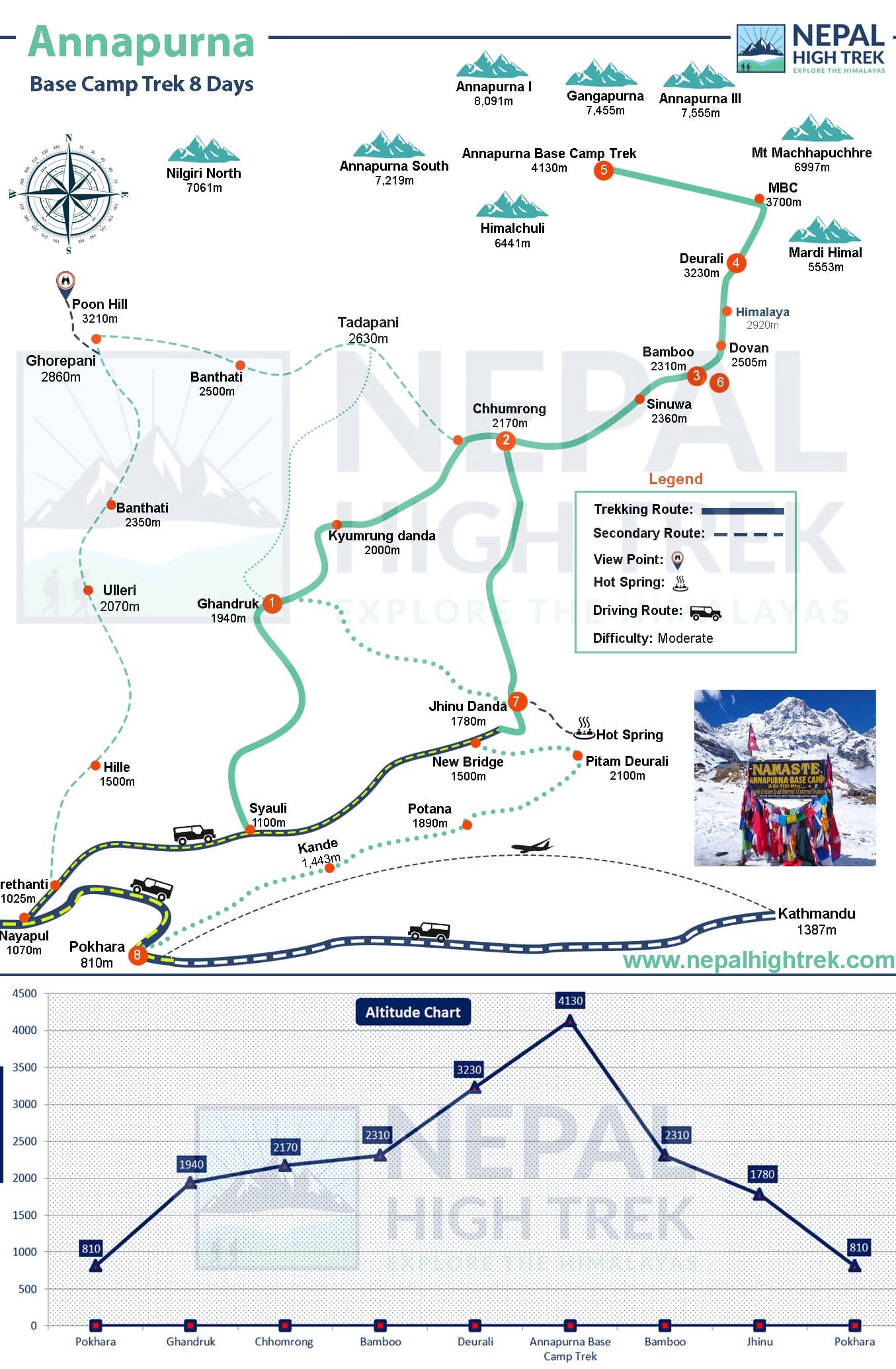
The 8-day Annapurna Base Camp Trek itinerary is carefully designed to balance walking hours, altitude gain, and acclimatization. The trek usually begins with a short drive from Pokhara to the trailhead, followed by scenic walks through traditional villages like Ghandruk or Chhomrong. Each day involves 5–7 hours of walking through forests, river valleys, and stone staircases. The route gradually ascends via Bamboo, Deurali, and Machhapuchhre Base Camp 3900 m before reaching Annapurna Base Camp 4130m.
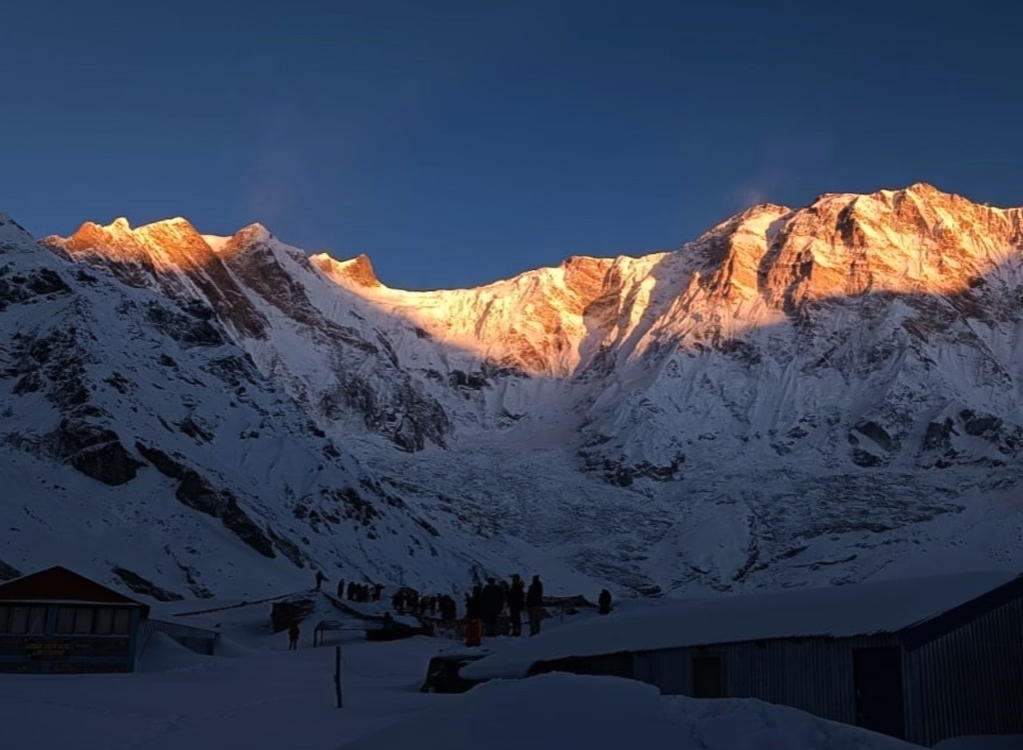
A sunrise at ABC is one of the trek’s most memorable moments. The return journey follows a similar route with a relaxing stop at Jhinu Danda, where natural hot springs provide a perfect recovery. This short itinerary is ideal for trekkers who want the full Annapurna experience without committing to a long expedition, while still ensuring safety and enjoyment.
Annapurna Base Camp Trek Route Map and Trail Description
The Annapurna Base Camp Trek route follows a well-established trail within the Annapurna Conservation Area, making navigation straightforward and safe. From the lower hills near Pokhara, the trail winds through terraced farmland, dense bamboo groves, and rhododendron forests. As the trek progresses, the landscape becomes increasingly alpine, with glacial rivers and dramatic mountain views.
The trail passes through culturally rich Gurung villages such as Ghandruk and Chhomrong, offering insight into local mountain life. Beyond Deurali, the route enters the Annapurna Sanctuary, a protected high-altitude basin surrounded by towering peaks. The final approach to Annapurna Base Camp is wide and gradual, allowing trekkers to enjoy panoramic Himalayan scenery. A detailed route map helps trekkers understand daily distances, elevation changes, and key landmarks, ensuring a well-planned and rewarding trekking experience.
Daily Walking Hours and Altitude Gain on ABC Trek
Daily walking hours on the 8 Days Annapurna Base Camp Trek typically range between 5 to 7 hours, depending on trail conditions and individual pace. The trek is designed with gradual altitude gain to reduce the risk of altitude sickness while maintaining steady progress. Lower sections involve frequent ascents and descents, especially on stone staircases around Chhomrong. As elevation increases, walking becomes slower but more scenic.
The biggest altitude gains usually occur between Deurali, Machhapuchhre Base Camp, and Annapurna Base Camp. Each trekking day includes sufficient rest breaks, lunch stops, and time to enjoy the surroundings. Descending days are generally shorter and less demanding. This balanced distribution of walking hours and altitude gain makes the trek achievable for trekkers with moderate fitness while still offering a genuine high-altitude Himalayan adventure.
Best Time to Do 8 Days Annapurna Base Camp Trek
The best time to do the 8 Days Annapurna Base Camp Trek is during spring (March to May) and autumn (September to November). Spring offers blooming rhododendron forests, mild temperatures, and colorful landscapes, making the trail especially scenic. Autumn is the most popular season due to stable weather, clear skies, and excellent mountain visibility.
Winter trekking (December to February) is possible for experienced trekkers, with fewer crowds and stunning snow-covered views, though colder temperatures and occasional snowfall should be expected. The monsoon season (June to August) brings lush greenery but also rain, leeches, and limited mountain views. For the best balance of comfort, safety, and scenery, spring and autumn are highly recommended. Nepal High Trek carefully plans departures during optimal seasons to ensure the best trekking experience.
Annapurna Base Camp Trek Difficulty and Fitness Level Required
The 9 Days Annapurna Base Camp Trek is considered a moderate trek, suitable for trekkers with reasonable physical fitness. No technical climbing skills are required, but the trail includes long uphill sections, stone steps, and high-altitude walking. Prior trekking experience is helpful but not mandatory. Regular walking, cardio exercises, and light hiking before the trek significantly improve comfort and endurance.
The maximum altitude of over 4,000 meters means trekkers should be prepared for thinner air and slower pacing. Mental readiness and a positive attitude are just as important as physical fitness. With proper acclimatization, professional guidance, and a steady pace, most healthy individuals can successfully complete the trek. Nepal High Trek ensures a well-planned itinerary, experienced guides, and safety support to make the journey manageable and enjoyable.
Maximum Altitude of Annapurna Base Camp Trek
The maximum altitude of the Annapurna Base Camp Trek is 4,130 meters (13,550 feet) at Annapurna Base Camp. At this elevation, trekkers are rewarded with breathtaking 360-degree views of some of the highest mountains in the world, including Annapurna I, Annapurna South, Hiunchuli, and Machhapuchhre. Reaching this altitude is a significant achievement, especially considering the relatively short duration of the trek.
Proper acclimatization, hydration, and a gradual ascent are essential to safely reach this height. While altitude sickness is less common compared to higher treks like Everest Base Camp, awareness and precaution are still important. The itinerary is designed to minimize risks by allowing adequate rest and gradual elevation gain. Standing at Annapurna Base Camp is a truly unforgettable Himalayan experience.
Cost of 8 Days Package of the Annapurna Base Camp Trek from Pokhara
The cost of the 8 Days Annapurna Base Camp Trek from Pokhara depends on group size, services included, and trekking season. Typically, the package covers professional guide and porter services, accommodation during the trek, meals, trekking permits, and ground transportation. Starting from Pokhara helps reduce overall costs by minimizing long-distance travel. Nepal High Trek offers transparent and competitive pricing with no hidden charges. The package provides excellent value by ensuring safety, comfort, and quality service throughout the trek.
Optional upgrades such as private rooms, additional acclimatization days, or luxury hotels in Pokhara can be arranged. Investing in a well-organized package enhances the trekking experience and allows you to focus on enjoying the journey rather than logistics. Nepal High Trek prioritizes fair pricing and ethical trekking practices.
Accommodation and Meals During the Annapurna Base Camp Trek
Accommodation during the Annapurna Base Camp Trek is primarily in teahouses, which are simple yet comfortable mountain lodges. Rooms usually feature twin beds with clean bedding, and blankets are provided at higher elevations. Bathrooms may be shared, especially in remote areas. Meals are freshly prepared and offer a variety of options, including traditional Nepali dal bhat, noodles, pasta, soups, rice dishes, and breakfast items.
Dal bhat is highly recommended for energy and nutrition during trekking. As altitude increases, food choices become simpler but remain filling and hygienic. Hot drinks such as tea, coffee, and ginger lemon honey are widely available. Nepal High Trek carefully selects reliable teahouses to ensure cleanliness, good food, and a pleasant stay throughout the trek.
Professional Trekking Guide and Porter Service in Annapurna Region
A professional trekking guide and porter service is essential for a safe and enjoyable Annapurna Base Camp Trek. Nepal High Trek provides experienced, licensed, and English-speaking guides with deep knowledge of the Annapurna region, culture, and trails. Guides ensure proper pacing, altitude management, safety monitoring, and cultural interpretation. Porters carry the main luggage, allowing trekkers to walk comfortably with just a daypack.
This not only enhances enjoyment but also reduces the risk of fatigue and injury. Nepal High Trek follows ethical trekking practices by providing fair wages, proper equipment, and insurance for guides and porters. Trekking with a professional team ensures smooth logistics, reliable accommodation, and quick response in emergencies, making your Himalayan journey secure and memorable.
Altitude Sickness and Safety Measures on ABC Trek
Altitude sickness is a potential risk on the Annapurna Base Camp Trek due to the elevation above 4,000 meters, but it is manageable with proper precautions. Symptoms may include headache, nausea, dizziness, and fatigue. Nepal High Trek prioritizes safety by designing itineraries with gradual ascent and adequate rest. Guides are trained to recognize early symptoms and take immediate action if needed.
Trekkers are advised to stay hydrated, eat well, walk slowly, and avoid alcohol. In severe cases, descent is the most effective treatment. Emergency evacuation arrangements can be made if necessary. First-aid kits and communication support are carried by guides at all times. With awareness, preparation, and professional support, the trek can be completed safely and confidently.
Flora, Fauna, and Landscape of Annapurna Conservation Area
The Annapurna Conservation Area is Nepal’s largest protected area and offers remarkable biodiversity. The lower regions are rich in subtropical forests with rhododendron, oak, bamboo, and pine trees. In spring, rhododendron blooms paint the hillsides in vibrant colors. As altitude increases, vegetation becomes alpine, with shrubs and grasses adapted to cold climates. Wildlife in the region includes langur monkeys, Himalayan tahr, musk deer, and various bird species such as pheasants and eagles. The landscape changes dramatically from terraced farmland and rivers to glaciers and snow-covered peaks. This diversity makes the Annapurna Base Camp Trek not just a mountain journey but a walk through multiple ecological zones, offering constant visual and natural interest.
Why Book Annapurna Base Camp Trek with Nepal High Trek ?
Booking your Annapurna Base Camp Trek with Nepal High Trek ensures a well-organized, safe, and memorable Himalayan experience. With years of experience in Nepal’s trekking industry, Nepal High Trek specializes in personalized service, ethical trekking practices, and professional guidance. The company offers carefully crafted itineraries, experienced local guides, and reliable porter support.
Transparent pricing, flexible customization, and strong local networks set Nepal High Trek apart. Safety is a top priority, with trained staff, proper acclimatization plans, and emergency support. Guest satisfaction and repeat clients reflect the company’s commitment to quality. Choosing Nepal High Trek means trekking responsibly while enjoying authentic hospitality and expert planning. Your journey to Annapurna Base Camp will be handled with care, professionalism, and passion.
Itinerary
Day 1: Drive to Nayapul; Trek to Ghandruk Village (1940 m); 4 – 5 Hrs
You will be picked up from your hotel or agreed meeting place in Pokhara. The trekking guide will brief you about the trek details and we will finalize the trip details before departing to Nayapul. We will hop on the private jeep or vehicle to Nayapul. It takes about 1.5 hours 2 hours to reach Nayapul from Pokhara. We will start the trek from this place even if you can take a jeep to Ghandruk to experience the classical Annapurna Base Camp Trek. Our permit will be checked in Birethanti and then we will trek uphill through terraced farmlands to Ghandruk Village via Kimche Village. Overnight in a tea house.
- 02
Day 2:Trek to to Chhomrung (2170 m); 6 – 7 Hrs
Early in the morning after breakfast, we will begin our trekking to Chhomrung. The trail descends to Kimrong Khola and climbs gradually to Chhomrong with fine views of Annapurna South and Machhapuchhre. Today’s trek is the first day of real walking. The trekking guide will decide whether to have lunch in Kimrong Khola or in Chhomrung according to the situation. For some trekkers who have good fitness level can go directly to Chhomrung for lunch. Overnight in a tea house
- 03
Day 3:Trek to Bamboo (2310 m); 5 – 6 Hrs
We will begin trekking after breakfast. The trail descends to Modi Khola, then ascend through dense bamboo and rhododendron forest to Bamboo village. Most of the sections of today’s trekking is through the green lush forests alongside the Modi River gorge. The sight of the gigantic hills can be so enticing experience while walking. Enjoy the tranquil time in the Bamboo village. Overnight in a tea house.
- 04
Day 4:Trek to Deurali (3260 m); 5 – 6 Hrs
As usual, today’s trek is also through the bamboo and rhododendron forests but we will witness gigantic waterfall and wild honey place near Dovan area where we might stop for lunch. It’s not fixed about the lunch stop as we can have lunch in Himalaya as well according to the situation on the trekking trail. The section between Dovan and Himalaya is steep uphill which can be tiring but other sections include flat and uphill sections okay to trek. Overnight in a tea house.
- 05
Day 5:Trek to Annapurna Base Camp (4130 m) via Machhapuchhre Base Camp (3700 m); 5 – 6 Hrs
Finally, we will reach the foothill of the world’s 10th tallest mountain Mt. Annapurna on this day. At first, we will walk on the banks of river and rugged rocky trail. We will then take the narrow trail along the narrow valley overlooking mountains all the way to the Machhapuchhre Base Camp where we will stop for a while before heading towards the Annapurna Base Camp. Once we reach the Annapurna Base Camp, we will take pictures and enjoy strolling around the place. In the evening, we will hike to the ridge near the base camp for acclimatization purpose and return back to tea house. Overnight in a tea house.
- 06
Day 6:Trek to Bamboo (2310 m); 6 – 7 Hrs
Early in the morning, we will wake up and hike to the nearby ridge for sunrise view. After gorgeous sunrise experiences, we will return back to tea house for breakfast. We will retrace the same trail back to Bamboo via Machhapuchhre Base Camp and Deurali. Overnight in a tea house.
- 07
Day 7:Trek to Jhinu Danda (1780 m); 5 – 6 Hrs
We will retrace the same trail back to Jhinu Danda via Sinuwa and Chhomrung. Upon reaching Jhinu, we will hike downhill to the natural hot water springs. In the evening, we will celebrate with the trekking crew members as it is the last day of the trek. Overnight in a tea house.
Day 8:Drive to Pokhara (822 m); 15 – 20 minutes’ Walk & 3 – 4 Hrs Drive
Today’s trek is just about 15 to 20 minutes to Samrung Danda. We will start the trek after breakfast and cross the suspension bridge to reach Samrung. Upon reaching Samrung, we will hop on the jeep and travel back to Pokhara. We will bid farewell in Pokhara with promise to meet again for another adventure in Nepal.
Are you looking to customize the trip itinerary?
If the provided schedule is not suitable for you, we can create a personalized travel arrangement tailored to your preferences and requirements.
Cost breakdown
What's included
Full board Meals During Trek:(Breakfast, Lunch, and Dinner)
Three times a cup of tea throughout the trip.
Trekking permit: ‘Trekkers’ Information Management System (TIMS) and ACAP Permit.
Pokhara to Nayapul and Samrung Khola to Pokhara by sharing a jeep.
7 night good accommodation on the trek.
Fresh fruit during the trek
An experienced, expert, helpful and friendly Guide from Pokhara (Included salary, meal, accommodation and insurance)
The arrangement of Emergency Helicopter service which will be paid by your Travel insurance company.
Medical kit bag.
What's not included
Your Travel and rescue insurance.
Porter fees $180
All the expenses in the mountain over than scheduled itinerary (due to strike, delay or canceled flight)
All the Bar bills and personal expenses (phone call, laundry service, battery recharge, a bottle of water, hot water, shower.
Tips for the guide and porter.
.avif&w=1920&q=75)